Two scatters or a third cone?
Identical-looking cones can send a spin in opposite directions. The trigger is the number of symbols, while the amount carried into the next event comes from their printed faces.
| Exactly two scatters | Add the two values. Their sum is the multiplier for wins on the next re-spin. A new pair during the sequence supplies the next multiplier. |
|---|---|
| Three or more scatters | The game moves to its Plinko Bonus. Add the triggering values to find the starting drops. Payout pockets come into play only when balls reach the board. |
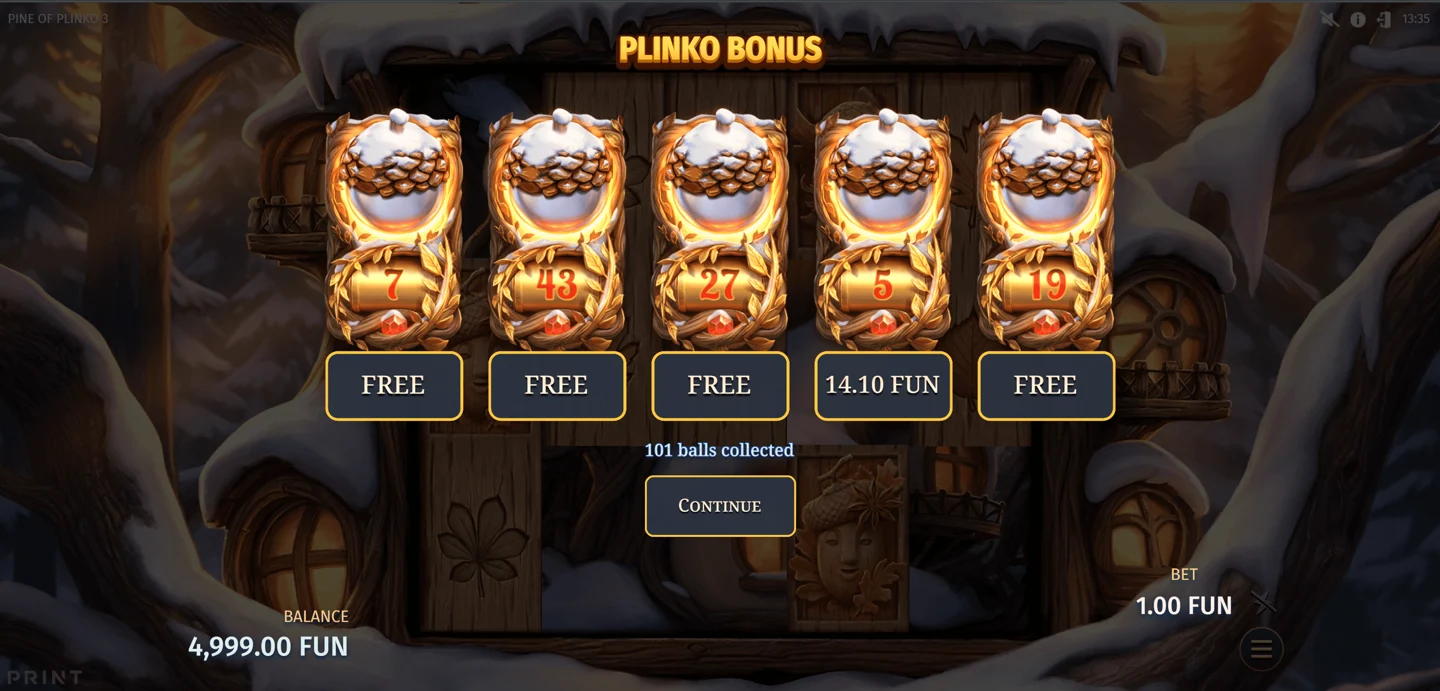
Reading the studio’s 101-ball screen
The five cones show 7 + 43 + 27 + 5 + 19. The total, 101, matches the balls-collected display at the top of the screen.
The 43 and 27 both contribute to the same collection. They are not separate awards, and there is no need to multiply the faces together. Compare the centre total with the individual labels before following what the reroll controls do.
The stake shown in this example is 1.00 FUN. That stake and the collection are displayed in different units. Reading 101 as a cash return would skip the entire part of the feature in which the balls meet the bumpers and pockets.
Keep the collection or reroll a cone
In the pictured state, the reroll below 5 costs 14.10 FUN. The controls below 7, 43, 27 and 19 say FREE. The price belongs to the individual control.
Continue is a complete decision on its own. Accepting the displayed values takes the current collection into the feature. Using a reroll instead changes the value being considered before the collection is settled.
The image gives a price and a current value. It gives no distribution of replacement values. There is enough information here to explain the control, but no basis for calling the paid choice an improvement on the displayed total of 101.